
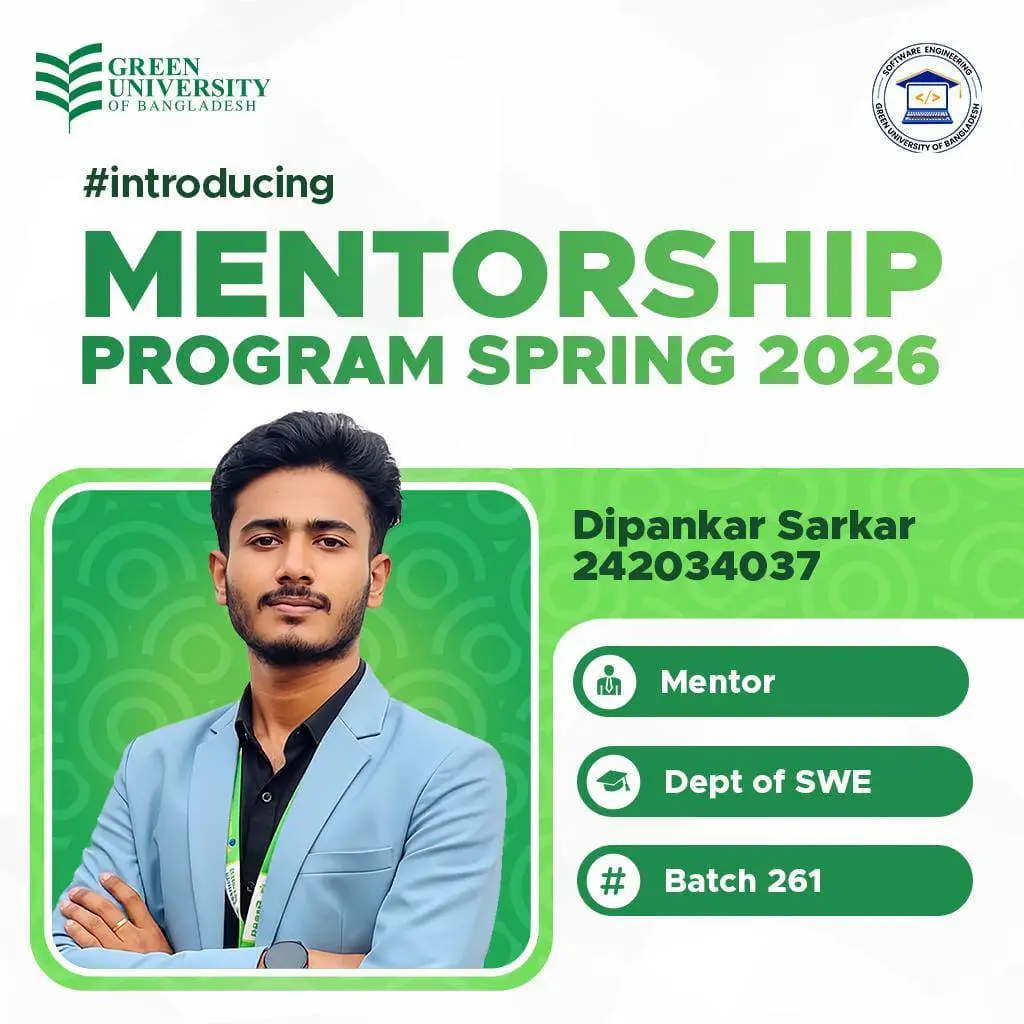
People often ask me how I manage to keep up with my coursework, run a university club, mentor junior students, and still find time for self-directed learning. The honest answer is: I do not always manage it perfectly. But I have found a rhythm that works — most of the time — and I want to share it.
This is not a productivity manifesto. It is not a list of apps or morning routines. It is simply an honest account of how I think about my time and my energy, and what I have learned from the moments when I got it wrong.
Start With What Cannot Move
Every week, I begin by identifying the immovable commitments: classes, scheduled club meetings, mentorship sessions. These are fixed. Everything else — personal study, project work, certificate courses, rest — gets scheduled around them.
This sounds obvious, but most students do the opposite. They treat their academic schedule as the skeleton and everything else as optional extras. Then the extras never happen, and when they do, they happen at the expense of sleep or health.
"Do not try to manage time. Manage energy. Time is fixed. Energy is renewable."
The Rule of Three
On any given day, I choose three things that must be done. Not ten. Not fifteen. Three. If I accomplish those three things — even if nothing else gets done — the day counts as a success. This single habit has done more for my consistency than any productivity system I have tried.
The key is that at least one of the three must advance my long-term goals, not just clear my inbox. Completing a course module, writing a section of a project, reviewing notes from a mentorship session. The daily grind is necessary, but so is forward movement on things that matter in five years.
How I Approach Mentorship Without Losing My Own Time
Mentoring juniors is one of the most rewarding things I do, but it can also be one of the most time-consuming if I am not careful. Early on, I would respond to every question the moment it came in. That fragmented my focus constantly.
Now I have office-hour style availability — certain times each week when I am fully present and responsive for mentees. Outside of those times, I batch my replies. This actually made me a better mentor, not a worse one. When I am focused during those sessions, I am more thoughtful and more helpful than I was when I was perpetually half-distracted.
Self-Learning: Small and Consistent Beats Large and Occasional
I have tried to commit to online courses with ambitious study plans — four hours every weekend, covering two or three modules at once. Almost without exception, those plans collapsed within two weeks. Life intervenes. Motivation fades. The gap between sessions grows until the course is effectively abandoned.
What actually works for me is fifteen to thirty minutes every weekday, without exception. Even on the days when I am exhausted and nothing sticks, the habit remains intact. On good days, thirty minutes becomes an hour. The consistency of the habit creates space for those good days to happen.
I currently have certificates from Udemy, Coursera, W3Topper, and others — not because I was spectacularly disciplined, but because I kept showing up in small increments, day after day.
On Rest and the Myth of Hustle Culture
There is a version of ambition that treats sleep as laziness and weekends as wasted opportunity. I have seen peers burn through their first year of university in a blaze of productivity — and then disappear from academic life entirely, hollowed out and exhausted.
Rest is not a reward for work. It is a prerequisite for it. I take Sunday mornings completely offline — no messages, no study, no planning. Just family, food, and whatever I feel like. That boundary is non-negotiable. It makes the rest of the week sustainable.
The One Question That Changed Everything
When I feel overwhelmed — pulled in too many directions, behind on too many things — I ask myself one question: "What is the one thing that, if I do it today, makes everything else easier or unnecessary?"
That question cuts through the noise. It forces clarity. And almost always, the answer is something I had been avoiding, not something I had forgotten. Addressing it directly creates momentum that carries through the rest of the day.
Final Thought
Balance is not a destination. It is a practice. Some weeks I am ahead on everything; other weeks I am barely keeping up. The goal is not to be perfectly balanced at every moment — that is an illusion. The goal is to build a life where, over time, the things that matter most get the attention they deserve.
If you are a student trying to do too much and wondering if it is sustainable — it is, with the right habits. Start small, protect your energy, and be honest with yourself about what actually matters.